Podcasts

In 2025, I was presented with two wonderful opportunities to chat with fellow colleagues on their podcasts.

First up, fellow pharmacist Saba Arshad and her Transform 360 Podcast.  We spoke a little about my career as a genetic counselor, pharmacist and entrepreneur.  Saba and I also dove briefly into MTHFR and how it has been simultaneously overhyped as causing nearly every health issue as well as dismissed as inconsequential when the real impact likely lies somewhere in between. https://www.iheart.com/…/episode-10-the-evolut
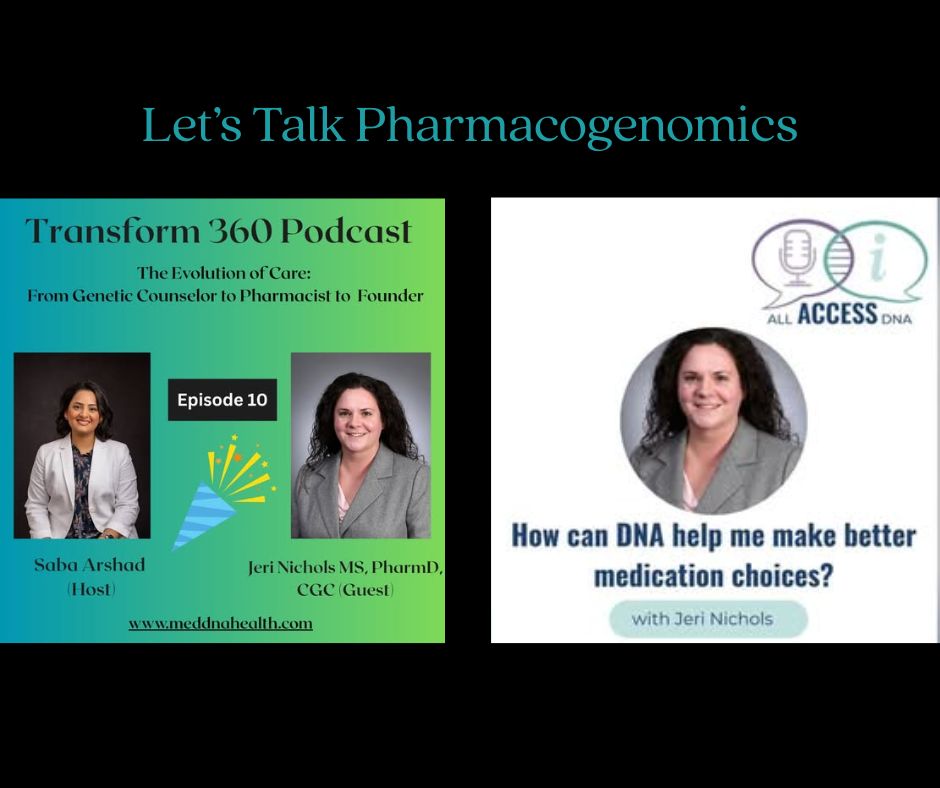
Podcasts discussing pharmacogenomics

Next, a conversation with fellow genetic counselor Kate Wilson on her All Access DNA Podcast.  Kate and I talk pharmacogenomics as I give a few real-world examples of how genetic information can be applied to medications.  I also advise caution to anyone taking a proton pump inhibitor (PPI) such as omeprazole or pantoprazole.  Listen in to find out why.   https://www.allaccessdna.com/episodes/pharmacogenomics
Give them a listen to learn a little more about pharmacogenomics and give these podcasts a follow!


Day 12 of 12 – PGx and NGx Education

Day 12 of 12 Education:

MTHFR.

What did you say? Is that some new abbreviated way of cursing?

No, but it sometimes feels like it. As a genetic counselor who had to start dealing with all the MTHFR variants showing up in prenatal clinic 25 years ago, I developed a real love/hate relationship with this gene.

The MTHFR gene produces an enzyme that is involved in processing folate and in converting the amino acid homocysteine to the amino acid methionine. If you have two copies of a variant called C677T, then you make only ~30% of the normal amount of MTHFR enzyme.

Reduced amounts of MTHFR enzyme have been linked to an increased risk for spina bifida in babies and has also been blamed for nearly every health condition that is known to man (or so it would seem if you searched the internet).

The truth is MTHFR does not exactly cause all these conditions, but it may contribute, as MTHFR does not act in a vacuum. The MTHFR pathway is intricately linked with many other pathways in the body, including neurotransmitter production, DNA synthesis, and detoxification. It is likely a combination of variants in MTHFR along with variants in other genes involved in the production of neurotransmitters and DNA synthesis that lends to MTHFR being associated with mood disorders, ADHD and some other conditions.

A nutrigenomics test gives you insight beyond MTHFR. Often supplementing with just folic acid, or preferably methyl-folate, will not be adequate. You may need to ensure adequate intake of other nutrients, such as B vitamins and choline to optimize brain function.

Remember, the nutrigenomics test looks at more than 130 genes and can give incredible insight to many of your body’s processes.

What are you waiting for?

Day 11 of 12 – PGx and NGx Education

Day 11 of 12 Education:

It is estimated that 1 in 5 adults in the US are dealing with mental illness. There is a myriad of medications on the market to treat depression, anxiety, bipolar and other mental health conditions.

How does a prescriber decide what to try? Multiple aspects are considered, such as the age of the patient, the symptoms they are dealing with, other medications they are on and other health conditions they have. However, deciding what medication to start with also often involves use of what the prescriber is personally comfortable with based on their experience with other patients.

As you have probably seen, a medication that works great for a friend may not work so well for you. Many antidepressants, antipsychotics and antianxiety medications have guidelines for prescribing when you know a person’s underlying genetics.

Having a pharmacogenomic test performed can give your doctor useful insight into how your genetics should factor into their prescribing recommendations. Having a PGx test means you are likely to deal with less trial and error…try a med for 3 months, it doesn’t work, try another for 3 months and so on.

I know individuals who have literally cried when they received their PGx report, and it validated why so many meds had not worked. And then they were able to go to their doctor and move to one that had a much greater chance of success.

If you have dealt with mental health issues and medication failure or side effects, a PGx test may be the best investment you make!

Day 10 of 12 – PGx and NGx Education

Day 10 of 12 Education:

Fatty acids are important building blocks for the human body. They are essential to the structure and integrity of cell membranes and are involved in other processes such as inflammation, immune responses and the production of hormones.

As an aside, I remember while in pharmacy school I mentioned fatty acids at the dinner table. My children would have been about 6 and 8 at the time and they busted up laughing like I had said some kind of crazy taboo curse word. For years after that they would say “fatty acids” randomly and start laughing. Now that I think about it, maybe to my kids it sounded a lot like fatty “donkeys”! I digress…

Two genes involved in how our bodies process fatty acids are FADS1 and FADS2. Variants in these genes can cause an imbalance in the ratios of fatty acids and contribute to having more of the ones that are inflammatory, such as arachidonic acid.

What can you do if a nutrigenomics test shows variants in FADS1 and/or FADS2? Use diet to help rebalance what is going on in your body. Take in less of the pro-inflammatory fats such as seed oils, eat more fatty fish, and consider Omega-3 supplements or specialized pro-resolving mediator (SPM) supplements.

Day 9 of 12 – PGx and NGx Education

Day 9 of 12 Education:

Dextromethorphan also known as the “DM” found in many cough and cold products is metabolized and inactivated in the body by an enzyme called CYP2D6.

The normal “half-life” or time it takes for the level of DM in a person’s body to be reduced by half is 2 to 4 hours. However, in people who are poor metabolizers (make zero or close to zero CYP2D6 enzyme), the half-life is 24 hours.

It takes approximately 5 half-lives to rid the body of 95% of a medication. This means CYP2D6 poor metabolizers will take ~5 days to get rid of a single dose of DM!!!

If DM makes you feel groggy, out of it, disconnected or “not right” and your best friend has no problem with the medication, genetics are likely the reason. You may be a poor or intermediate metabolizer of CYP2D6. A pharmacogenomic test can give you answers.

Day 8 of 12 – PGx and NGx Education

Day 8 of 12 Education:

Do you experience any of the following: migraines, stomach issues, dizziness, flushing, itching, anxiety, fatigue, sinus issues?

Your body may be prone to histamine overload. This isn’t an issue of “allergies”. Rather, it is an issue that your body has difficulty breaking down and clearing histamine.

A nutrigenomics test can identify variants in two genes, HNMT and DAO, that when present make a person more susceptible to histamine overload and the above mentioned symptoms.

Individuals with histamine overload can be advised to make sure they have adequate intake of nutrients such as copper, vitamin C and vitamin B6 which are cofactors for the DAO and HNMT enzymes to breakdown histamine. NSAIDs, alcohol and aspirin also activate histamine and can be avoided. Changes to diet may also be necessary to avoid foods that release histamine (soy sauce, egg whites, smoked meats) and instead favor foods that help breakdown histamine (egg yolks, berries, broccoli).

If you suspect you have histamine overload, a nutrigenomics test may be what you need to set yourself on a path to better health.



Day 7 of 12 – PGx and NGx Education

Day 7 of 12 Education:

It is estimated that cancer will affect 1 in 3 women and 1 in 2 men during their lifetime.

Breast and colon are two very common cancers. Both types of cancer are often treated with a drug called a “fluoropyrimidine” such as capecitabine (Xeloda) and 5-fluorouracil that

disrupts DNA and RNA synthesis.

These medications can be effective in treating cancer, but for a 1000 or so people each year in the US, they are deadly.

These medications are metabolized by an enzyme, DPYD. Genetic variants in the gene can mean a person makes less of this enzyme than expected. Having low, or sometimes absent, enzyme levels place a patient at risk for toxicity from the chemo drug and this toxicity can include death.

A pharmacogenomics test can look at the DPYD gene for common variants and if one or two copies are identified, then the doctor can use this information to either decrease the starting dose of the chemo drug or pick an entirely different drug.

Knowledge of your DPYD gene status won’t eliminate the risk of toxicity and death from fluoropyrimidines, but it does significantly reduce the risk.

You can use information from a pharmacogenomics test for years to come. No need to wait until you actually need the information, get tested soon.

Day 6 of 12 – PGx and NGx Education

Day 6 of 12 Education:
Hypothyroidism, also known as low thyroid function, affects about 10% of the population in the United States. Standard treatment is replacement of the T4 (thyroxine) hormone using levothyroxine (Synthroid).

T4 must be converted to a thyroid hormone called T3 (triiodothyronine). This is accomplished by an enzyme called DIO2. Some individuals have a variant in the DIO2 gene that results in the body not converting T4 to T3 as efficiently as it should.

Individuals with hypothyroidism who have a variant in DIO2 often don’t feel as well as they should when taking levothyroxine. These individuals would benefit from additional T3 supplementation in the form of a medication called liothyronine (Cytomel). Alternatively, patients with hypothyroidism can be given a desiccated thyroid medication (Armour Thyroid, NP Thyroid) that contains a combination of T3 and T4.

Since levothyroxine is considered “standard of care”, many prescribers are hesitant to prescribe another thyroid medication, even though it may be exactly what the patient needs. It is

also standard practice to order TSH and T4, often neglecting to look at T3 levels which are incredibly important.

A nutrigenomics test will let you know if you have this variant in DIO2 and may help you convince your doctor to explore a different treatment option if you are not receiving optimal results from levothyroxine.

In addition, the DIO2 gene variant appears to be associated with poorer blood sugar control in diabetics and increased risk for developing insulin resistance. Knowledge of this variant may be the additional piece of information you need to get on a healthier diet path.

Day 5 of 12 – PGx and NGx Education

Day 5 of 12 Education:

PPIs, also known as proton pump inhibitors, are one of the most widely used medications on the market. PPIs are available over the counter and by prescription. They include omeprazole

Proton pump inhibitors and CYP2C19(Prilosec), esomeprazole (Nexium), pantoprazole (Protonix), lansoprazole (Prevacid), rabeprazole (AcipHex), dexlansoprazole (Dexilant).

Several PPIs are metabolized by CYP2C19. If you are a poor metabolizer for this enzyme, you may be at increased risk for side effects from some PPIs. If you are a rapid metabolizer, you may be at risk for the PPI not helping you.

In addition, PPIs are often over-used and over-prescribed. Most individuals should use these medications for no longer than a few months. Long term use increases your risk for bone fractures, infections,

vitamin deficiencies, dementia and chronic kidney disease.

If you are on a PPI, talk with your prescriber about getting to the root cause of why you needed the PPI in the first place and address the root cause (obesity, certain foods, eating too close to bedtime, certain medications, an overgrowth of certain bacteria in your gut).

Addressing the root cause will likely allow you to stop the PPI.

A pharmacogenomic test will determine what type of CYP2C19 metabolizer you are and therefore help guide prescribing the most appropriate PPI for you. Pharmacogenomic test results help guide prescribing of many other types of medications too.

Day 4 of 12 – PGx and NGx Education

Day 4 of 12 Education:

Nutrigenomic testing looks at more than a dozen genes involved in production, utilization and processing of hormones in the body.

Women with polycystic ovarian syndrome (PCOS) will often have variants in several of these genes, including ESR2, CYP17A1 and CYP19A1. Knowledge about these variants can assist in lifestyle modifications to improve hormone health and reduce unwanted effects of PCOS.

Recommendations will depend on the genes involved but may include advice such as increasing intake of phytochemicals. This can be accomplished through supplementation with curcumin or eating raw cruciferous vegetables.